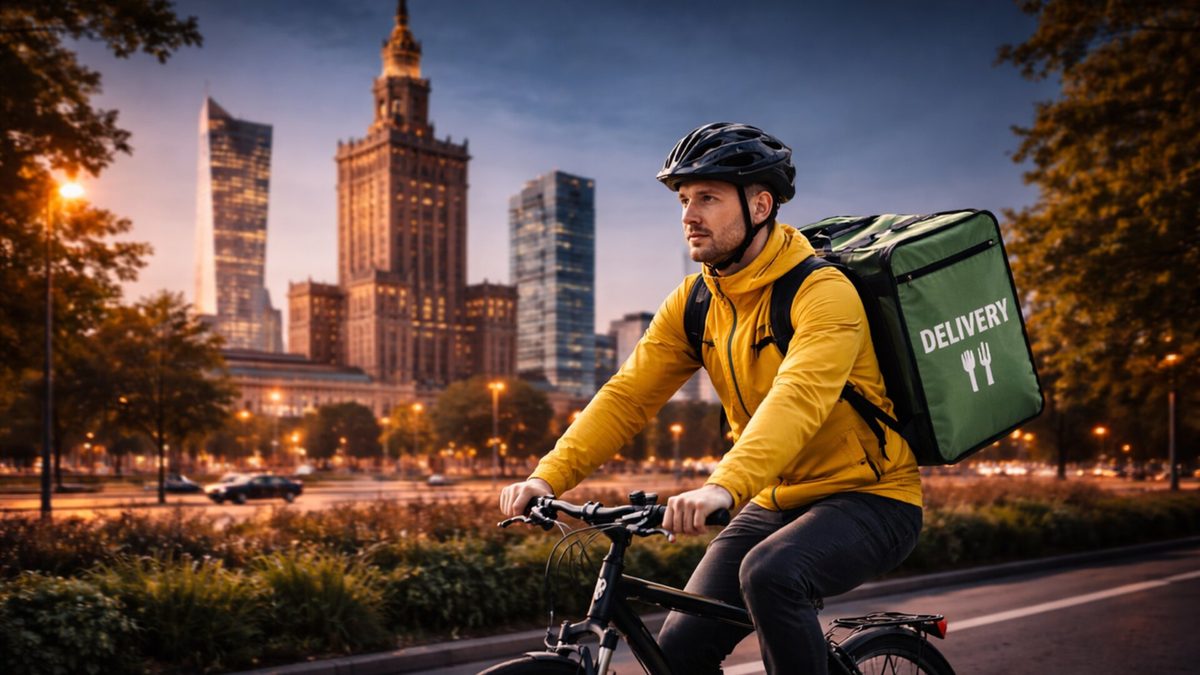
Food delivery work in Malbork with flexible schedule
Glovo · Uber Eats · guidance during registration
Online registration · Flexible schedule · Partner: 8+ years, 11 offices in Poland
~38 k
residents
2
platforms
Fri–Sun · season
weekly peak
Tourist city
city type
Malbork lives in the shadow of Europe's largest brick castle, a UNESCO World Heritage site, and it sets the town's calendar. Thirty-eight thousand residents, plus a steady stream of visitors that peaks from May through September but never fully disappears in winter. You'll see the seasonal swings in the app just as clearly as the guides at the ticket counters.
Restaurants cluster downtown and along the strip leading to the castle, busiest in summer. You'll deliver to hotels, guesthouses, and rental apartments, and off-season mostly to housing estates across the Nogat River. Supermarkets and shops along the road to Gdansk add grocery orders year-round, even when tourists are nowhere in sight.
What to know — Malbork
Best hours
Best earnings come during lunch 12-14 and dinner 18-22, especially weekends.
Weather edge
Tourist season summer is busiest, winter brings fewer orders but less competition.
Transport
A bicycle works well in Malbork — short distances and tourist zones near the castle.
Which transport works for food delivery
Ride whatever feels right — the choice is yours.
Bicycle
Short central runs, nothing spent on parking
E-bike
Go further without arriving out of breath
E-scooter
Light and nimble in city traffic
Scooter
Quicker than a bike, nimbler than a car
Moped
Covers more ground than a kick scooter
Car
Heavier baskets, plus drops outside the centre
Your kit before the first delivery run
Thermal bag
The partner has them for sale
Powerbank
Yours to sort out
Transport
Rent from the partner or use your own
Your route to the first order
1
Online registration
Leave your details in the form; it's minutes of work.
2
Talk to the partner
The partner walks you through the forms and the contract.
3
Connect the apps
Your delivery accounts are ready — you can take orders.
4
Start delivering
You decide the hours, then the money follows.
Frequently asked questions
How much can you earn as a food delivery courier?
You typically take home 25–55 zł an hour depending on the city, time and weather — that is after deductions, not gross. On Uber Eats in heavy rain or snow it can reach 60–80 zł/h: fewer couriers are out and the orders pile up. Your result depends on how many orders you accept, the distances and the bonuses running in that app. You see the rate for every job in the app before you accept it.
What documents do you need to work as a courier?
Basics: a valid ID or passport, PESEL number, and a Polish bank account for payouts. Non-EU foreigners also need a residence card, work-permit visa or UKR status (for Ukrainians). Cars and scooters require a driver's licence and vehicle papers. The whole verification runs online, usually through a settlement partner.
How does registration work and how long does it take?
You sign up online with a settlement partner — fill in the form, upload your documents, sign the contract. The partner then activates your account in the apps you chose. Bolt Food usually the same day or the next one, Uber Eats within 24–72 hours. With Wolt and Glovo the timing depends on whether your city is currently recruiting couriers — if it is, that's a couple of days. Your advisor checks this before you gather any paperwork.
How do tips work and does the courier keep all of them?
Tips come on top of the delivery fee — Bolt Food states officially that the courier keeps 100%. Wolt also adds tips on top of the payment for the job. Uber Eats is the weak spot: since 2024 customers in Poland effectively have no way to tip through the app. Don't budget around tips — treat them as a nice extra rather than part of your rate.
What taxes and contributions do couriers pay on a civil contract (umowa zlecenie)?
Your settlement partner handles it: it registers you with ZUS, withholds the income tax advance and issues a PIT-11 once the year closes. How much comes off depends on your age and on whether you have another job or student status. The figures you see in the app are gross, so less lands in your account. The sickness contribution is optional, but without it there is no benefit if an injury keeps you off the road. In short: under 26 no income-tax advance is withheld (young person’s relief — no student status needed, 85,528 zł yearly limit); ZUS contributions are waived only for pupils and students under 26 — without that status deductions are roughly 19%, and after 26 income tax is added on top.
How do cash orders work?
Bolt Food brought cash back in 2026 across every Polish city — you need no float and no change, and you hand takings in at restaurants on later pickups. On Uber Eats cash is deducted from your next cashless payouts, and you can switch it off completely in the settings. Wolt caps the cash you can hold at 300 zł; go over that and your account drops offline. On Glovo cash settles outside the settlement partner, so if something doesn't add up, message platform support.
What should you do if the app blocks your account?
Only the platform can lift a block — your settlement partner has no access to it, so write to app support straight away. Bolt Food lists the reasons plainly: low acceptance rate, sharing an account, the wrong vehicle type, cash-settlement problems and poor ratings. You have the right to appeal a block, guaranteed by EU platform regulation. On Uber Eats, repeatedly arriving late at pickup also brings a temporary block — usually around 90 minutes the first time.
How it works, step by step
1
Register with partner
Fill in the form with our settlement partner — they prepare the contract and connect you to the apps.
✓ 6,100+ couriers settle with the partner every week · 8+ years on the market · 11 offices in Poland
✓ 6,100+ couriers settle with the partner every week · 8+ years on the market · 11 offices in Poland
Register
New tab — this page stays open
2
The app on your phone
Right after signing up, download the app and log in with the password from the SMS — it handles your settlements, payouts and advisor contact.Get it onGoogle PlayDownload on theApp Store
3
Register with delivery services
Choose and register with one or more delivery services. You can work with multiple apps at the same time.
4
Done!
Malbork — start today