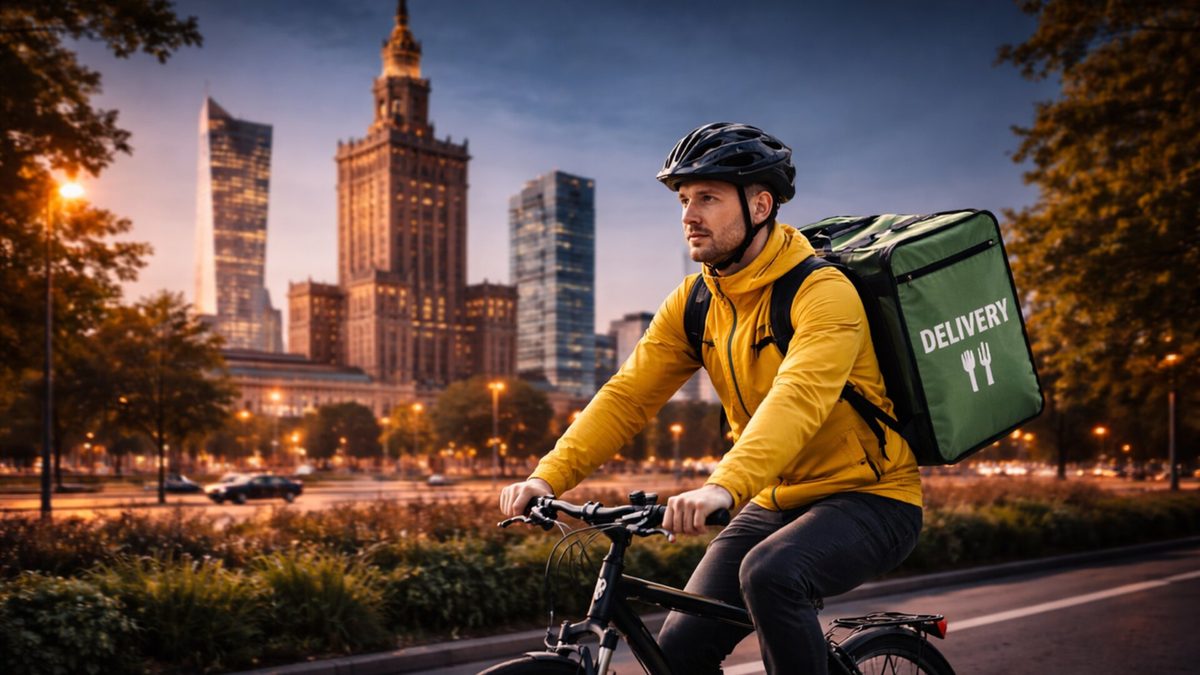
Start food delivery courier work in Krosno today
Food delivery · Glovo · Uber Eats · flexible format
Online registration · Flexible schedule · Partner: 8+ years, 11 offices in Poland
~47 k
residents
2
platforms
Fri–Sun
weekly peak
Small city
city type
Krosno combines industry - glassmaking above all - with its role as gateway to the Bieszczady mountains. Year-round it runs on its own 47,000 residents plus the surrounding communities, and spring through autumn adds passing traffic headed for the mountains. May and August weekends look quite different here from a typical county town.
The historic market square, with its arcades, and the streets around it form the densest cluster of restaurants. Deliveries go to housing estates, the factory and airport area, and single-family homes on hills on both sides of the Wislok valley. Some orders reach smaller towns that lack restaurants of their own - a longer route, but less competition for the order.
What to know — Krosno
Best hours
Busiest hours are lunch 12-14 and dinner 18-22 on weekends.
Weather edge
Rain and winter mean fewer couriers and more orders for you.
Transport
Hilly terrain favours scooters or cars over bicycles outside the centre.
Which transport works for food delivery
Ride whatever feels right — the choice is yours.
Bicycle
Short central runs, nothing spent on parking
E-bike
Go further without arriving out of breath
E-scooter
Light and nimble in city traffic
Scooter
Quicker than a bike, nimbler than a car
Moped
Covers more ground than a kick scooter
Car
Heavier baskets, plus drops outside the centre
Your kit before the first delivery run
Thermal bag
The partner has them for sale
Powerbank
Yours to sort out
Transport
Rent from the partner or use your own
Your route to the first order
1
Online registration
Leave your details in the form; it's minutes of work.
2
Talk to the partner
The partner walks you through the forms and the contract.
3
Connect the apps
Your delivery accounts are ready — you can take orders.
4
Start delivering
You decide the hours, then the money follows.
Frequently asked questions
How much can you earn as a food delivery courier?
You typically take home 25–55 zł an hour depending on the city, time and weather — that is after deductions, not gross. On Uber Eats in heavy rain or snow it can reach 60–80 zł/h: fewer couriers are out and the orders pile up. Your result depends on how many orders you accept, the distances and the bonuses running in that app. You see the rate for every job in the app before you accept it.
What documents do you need to work as a courier?
Basics: a valid ID or passport, PESEL number, and a Polish bank account for payouts. Non-EU foreigners also need a residence card, work-permit visa or UKR status (for Ukrainians). Cars and scooters require a driver's licence and vehicle papers. The whole verification runs online, usually through a settlement partner.
How does registration work and how long does it take?
You sign up online with a settlement partner — fill in the form, upload your documents, sign the contract. The partner then activates your account in the apps you chose. Bolt Food usually the same day or the next one, Uber Eats within 24–72 hours. With Wolt and Glovo the timing depends on whether your city is currently recruiting couriers — if it is, that's a couple of days. Your advisor checks this before you gather any paperwork.
Can you choose orders or are they assigned randomly?
Each platform works differently. Wolt and Bolt Food show the order before you accept — you can decline if it is too far or pays too low. Glovo auto-assigns within your booked slot, but you can decline without big consequences if your rating is solid.
Is it safe to work in the evening?
Evenings are the most profitable part of the day and most couriers ride shift after shift without a single incident. Phone numbers are hidden on both sides and all contact goes through the app, so the customer never sees your number. Cash is the real risk: hand your takings in during the shift instead of carrying them around until the end of the day. Settlement-partner support runs 7 days a week in Polish, English, Ukrainian, Russian and Turkish.
Can you work through the winter and what changes?
Winter is the strongest season: November and December bring the highest multipliers and the best quests, while summer is a clear low point. Order volume rises because people stay in, and plenty of couriers simply skip the cold and the snow. Warm touchscreen gloves, a waterproof jacket and decent boots pay for themselves within two shifts. On icy roads a bike or e-scooter gets risky, so many couriers switch to a car for the winter.
Is it worth using your own car, and who pays for fuel?
Fuel, servicing and parking are on you — since July 2026 Glovo no longer accepts expense invoices for fuel, parts or gear. A car earns its keep on the outskirts, on large grocery orders and in winter, while a bike usually wins in a tight city centre. Valid motor third-party cover (OC) is mandatory and platform insurance doesn't replace it. The settlement partner also offers its own insurance packages (OC, AC, NNW, assistance) for people driving for apps.
How it works, step by step
1
Register with partner
Fill in the form with our settlement partner — they prepare the contract and connect you to the apps.
✓ 6,100+ couriers settle with the partner every week · 8+ years on the market · 11 offices in Poland
✓ 6,100+ couriers settle with the partner every week · 8+ years on the market · 11 offices in Poland
Register
New tab — this page stays open
2
The app on your phone
Right after signing up, download the app and log in with the password from the SMS — it handles your settlements, payouts and advisor contact.Get it onGoogle PlayDownload on theApp Store
3
Register with delivery services
Choose and register with one or more delivery services. You can work with multiple apps at the same time.
4
Done!
Krosno — start today